Showing posts with label 2010 Book Challenge. Show all posts

Monday, 12 April 2010

Jane Eyre and Cirian Hinds

Jane Eyre (A&E, 1997)Genre: Classic Movie

How I watched it: I own it.

What attracted me to the movie: I admit, I snatch up all classic movies when they come along. Especially, British ones and especially ones with Ciaran Hinds. He's one of my favorite actors. Not the handsomest but one of the best.

What it worth the money? Yes.

Who should watch this movie: If you've read Jane Eyre, then watch this version. There are some other versions (also good) but this one, the chemistry is wonderful between Morton and Hinds. IMHO.

Summary (from amazon): The fascinating British actress Samantha Morton stars as the titular heroine in this provocative version of Jane Eyre, based on Charlotte Bronte's oft-filmed, 1847 novel. The familiar contours of Bronte's story are all here: Jane, the unhappy orphan, grows up to become governess at Thornfield, a gloomy estate owned by the imperious and worldly, but curiously desperate, Mr. Rochester (Ciarán Hinds). While the latter's grasping attentions stir the inexperienced young woman, the gothic goings-on at Thornfield suggest layers of unwholesome secrecy in Rochester's life. Most productions of Jane Eyre carefully reflect Bronte's absorbing balance between romance, horror, and Jane's psychological passage to adulthood. But this 1997 television movie is interesting for its near-reckless emphasis on Jane and Rochester's mutual obsession and galloping jealousies. The dramatic strategy throws off the story's overall tone, but such problems are worth it to see Morton and Hinds explore Jane Eyre's darkest possibilities. --Tom Keogh

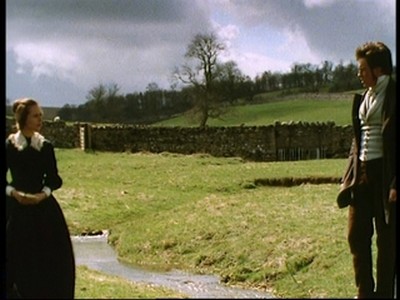
My thoughts: Have I said I love this movie? I think that nicely sums it up. This is one of the best scenes in the movie, it's the proposal scene. The chemistry is wonderful. I like how they cut some of the boring parts of the book out in the movie.You can watch the bit below.

Bottom Line: Don't watch the movie if you haven't read the book, but if you have, what are you waiting for?

Rating:


I have received a wonderful gift from Marce at Tea Time With Marce. She was giving away books to some who took her button. She has a wonderful writing blog and so you should check her out. Click her button below.

Monday, 29 March 2010

Review: One Last Breath by Stephen Booth

One Last Breath
Genre: Psychological Suspense Mystery

How I read it: Kindle for PC

What attracted me to the book: This series of books has been on my list for awhile. I first came across the series in a book store in Saskatoon, SK, Canada and have been wishing for the books ever since. I finally bought my first book on Kindle. Finally.

What it worth the money? I didn't pay much for it on amazon, so I guess so. It's exactly what I've come to expect from my British mystery writers and haven't been disappointed with this one.

Who should read this book: If you're into books by Val McDermid or Ian Rankin, you may like this book

Summary (from amazon): British author Booth's fifth crime novel (after Blind to the Bones) is as dark and winding as the labyrinth of caves below its Derbyshire setting. In 1990, Det. Constable Ben Cooper's father arrests Mansell Quinn for the brutal murder of his lover. Thirteen years later, Quinn disappears upon his release from prison, his ex-wife is immediately slain, and another murder soon follows. Convinced they're facing a revenge spree, the police mount a manhunt, probing physical clues and the messy web of relationships that Quinn has not quite left behind. The deeper Cooper and his colleagues probe, the more convinced Cooper becomes that Quinn was innocent of the original crime, a belief that deepens his sense that as the son of the arresting officer, he's personally at risk. Though the pace and focus falter slightly toward the end, this is intelligent, suspenseful reading that should continue to build Booth's U.S. audience. A master of psychological suspense, Booth hauntingly evokes the ambiguities of place and the enduring complexity of human relationships.

My thoughts:This book scared me at times because of the many scenes in the cave. I'm terribly claustrophobic. Even now, just the thought of some of the scenes sends shivers down my spine. In the book, there is a very haunting story told - it's not true (or so I hope...) but, it will stay with me for months.

Now, about the main characters.s: Detective Constable Ben Cooper and Detective Sergeant Diane Fry. Though, I related more to Cooper than Fry, I wanted to love Fry. I wanted Cooper and Fry to fall in love, I wanted them to express that love but I closed the book not quite understanding Diane. That could be an annoying point for some but I think it has to be that way or the series might not go on.

The plot, I think, was the weakest point. I think the writer tried to focus on two cases in the book and both didn't seem to resolve well enough for me. We think we know what happened but you're left with doubts. The first chapter opened in such a thrilling manor, I guess I was expecting that momentum to last to the last page. Not saying that the story didn't have great moment - it did - but I wanted more from the end.

Did I figure out who the murderer was before the main character(s): Not sure I could say yes to this. Not quite sure when the main character found out if ever... oh dear, I've said too much.

Bottom Line: Though I love Val McDermid more, I think I will give this author another read. Visit the author's blog: here

Rating:


Monday, 22 March 2010

Review: The Killings at Badger's Drift by Caroline Graham

G'day, everyone. I'm back from vacation and I can't say how happy I am about that fact. Enjoy my latest Monday book review!


Buy the book!
Genre: Cozyish mystery - I say this because there are some gruesome scenes.

How I read it: I own the book.

What attracted me to the book: I love watching the series on TV.

What it worth the money? Her books are cheap. You can probably find hundreds of her books in a used book store... so yes.

Who should read this book: Everyone who loves a clever whodunit.

Summary (from amazon): The British author makes her debut here in an uncommonly appealing mystery, set in a tranquil village, Badger's Drift. Learned Chief Inspector Barnaby and callow Sergeant Troy go to work when importunate, elderly Miss Bellringer insists that her friend, Emily Simpson, did not die of a heart attack as her doctor claimed, but was murdered. An autopsy proves Miss Bellringer right; Emily had imbibed a Socratic mix of wine and hemlock. Spreading alarm throughout the community, an unseen murderer strikes again, leaving sly Mrs. Rainbird's bloody corpse to be found by her son, the local undertaker. As Barnaby and Troy investigate, they turn up evidence of another crime years earlier, and several suspects. Among them are the doctor's promiscuous wife, a young woman whose brother objects to her marriage to a rich widower and a Lady Chatterley-type gamekeeper. Diligent detecting brings the chief and his bumbling assistant to a sensational expose. Graham makes the characters humanly believable in her witty and tragic novel, a real winner.

My thoughts: I just realized that Edward Martin talked about Midsomer on his blog today too. I read this book a long time ago and wanted to re-read it because of the 2010 challenge. I'm glad I did. I own quite a few of Graham's books, some with Inspector Barnaby as the main character, some not.

Perhaps because this is her first book, she doesn't fill it with massive amounts of description. She keeps the book to the point and only adds the exciting bits. I loved all the off-the-wall characters. I actually like to read first books from authors, before the publishing world really sinks their claws into the writers and demands word count and formula. I felt the way about Elizabeth George's first book as well. Since then, both authors have produced longer books with more filler.

I think once you read this book, you will not forget the premise. I give a warning however...some of the themes in his cozy mystery are not suitable for younger adults.

Did I figure out who the murderer was before the main character(s): I suspected something but how it was done exactly eluded me.

Bottom Line: She writes wonderful books. She's an easy read. A great series to start and start here.

Rating:


An Extra: Here's a pic from my garden.

Monday, 8 March 2010

Jane Eyre by Charlotte Bronte


Genre: Literary Classic
How I read it: I own the book

What attracted me to the book: It's a classic. If you haven't read it... what are you waiting for?
What it worth the money? Is the sky blue?

Who should read this book: This book is not for everyone...
do not read if you 
a) don't have a brain 
b) don't live on planet earth 
c) don't know what a car is 
d) have never ate a carrot.

Summary (from amazon): Part fairytale, part Gothic horror, part love story, Jane Eyre remains one of the most compelling novels ever written. After running away from her unloving and cruel aunt, the orphaned Jane endures a harsh existence at an Evangelical school, where she at least finds some friends and kindness. When she comes of age, she takes a position as governess to the children of the moody, Byronic Mr. Rochester. As time passes, she begins to fall deeply in love with her magnetic employer...but soon realizes that both he and his dark and shadowy mansion hide a terrible secret.

My thoughts: I don't really want to talk about Jane Eyre (the book) as much as I want to talk about Jane Eyre (the character). In many ways I related to Jane Eyre and mostly because she was a thinker. She thought through her options before she decided. I doubt Jane made a rash decision.

For instance: In the beginning of the book, Jane Eyre was asked: (Notice how she thoughtfully debated the question)
“Would you like to go to school?”
Again I reflected: I scarcely knew what school was: Bessie sometimes spoke of it as a place where young ladies sat in the stocks, wore backboards, and were expected to be exceedingly genteel and precise: John Reed hated his school, and abused his master; but John Reed’s tastes were no rule for mine, and if Bessie’s accounts of school-discipline (gathered from the young ladies of a family where she had lived before coming to Gateshead) were somewhat appalling, her details of certain accomplishments attained by these same young ladies were, I thought, equally attractive.  She boasted of beautiful paintings of landscapes and flowers by them executed; of songs they could sing and pieces they could play, of purses they could net, of French books they could translate; till my spirit was moved to emulation as I listened.  Besides, school would be a complete change: it implied a long journey, an entire separation from Gateshead, an entrance into a new life.
“I should indeed like to go to school,” was the audible conclusion of my musings.

 Example 2 - When Jane had decided to leave Mr. R after the revelation, she decided to leave in the dead of night to avoid further confrontations:
It was yet night, but July nights are short: soon after midnight, dawn comes.  “It cannot be too early to commence the task I have to fulfil,” thought I.  I rose: I was dressed; for I had taken off nothing but my shoes. [...]
I would have got past Mr. Rochester’s chamber without a pause; but my heart momentarily stopping its beat at that threshold, my foot was forced to stop also.  No sleep was there: the inmate was walking restlessly from wall to wall; and again and again he sighed while I listened. [...]
That kind master, who could not sleep now, was waiting with impatience for day.  He would send for me in the morning; I should be gone.  He would have me sought for: vainly.  He would feel himself forsaken; his love rejected: he would suffer; perhaps grow desperate.  I thought of this too. 

Jane Eyre in all her troubles show strength of character that many would have faltered under. I think of her as truly a strong woman.

Side note: I found a website where the story is summed up in a minute or less. Do not go to the link if you have never read the book... it's funny but has spoilers.

Rating:

Monday, 22 February 2010

Why didn't they ask Evans by Agatha Christie

Why Didn't They Ask Evans? (St. Martin's Minotaur Mysteries)
Genre: Agatha Christie MysteryHow I read it: I own the book.

What attracted me to the book: It's an Agatha Christie and I've read all her books.

What it worth the money? Her books are cheap. You can probably find hundreds of her books in a used book store... so yes.

Who should read this book: Everyone!

Summary (from amazon): Was it a misstep that sent the handsome stranger plummeting to his death from a cliff? Or something more sinister? Fun-loving adventurers Bobby Jones and Francis Derwit's suspicions are certainly aroused-especially since the man's dying words were so peculiar: Why didn't they ask Evans? Bobby and Francis would love to know. Unfortunately, asking it of the wrong people have sent the amateur sleuths running for their lives-on a wild and deadly pursuit to discover who Evans is, what it was he wasn't asked, and why the mysterious inquiry has put their own lives in mortal danger...

Sean Biggerstaff plays Bobby in the movie
My thoughts: I love all of AC's mysteries, she has created some of the greatest plot lines in all of history. But, what made me love this book was not the mystery as much as the chemistry between the two MCs. Francis, the female MC is witty, adventurous and rich. I bonded with her immediately. Some of the things she did in the book were outrageous and funny.

However, AC doesn't leave the mystery lover hanging. This book has: a chase for an unknown murderer, a near-death poisoning for Bobby, multiple disguises for Bobby and Frankie, a plot to do with mistaken identity, a subplot of a mental hospital and a lunatic patient, a scheme of faking a will, a murder in a locked room, a scheme with impersonations, and a thriving drug business.

Did I figure out who the murderer was before the main character(s): No, but I wasn't really trying to piece the clues together in this one. I was along for the ride.

Bottom Line: If you haven't read Agatha Christie yet, why not? Get started already!

Rating:

Monday, 15 February 2010

Pretty is as Pretty Dies by Elizabeth Spann Craig

Pretty is as Pretty Dies: A Myrtle Clover Mystery (Myrtle Clover Mysteries)Genre: Cozy Mystery
How I read it: Kindle for PC

What attracted me to the book: The title and the awesome cover! Love the gnomes. Maybe because I love the TV show Amazing Race.

What it worth the money? Yes.

Who should read this book: If you love cozy mysteries set in small American towns with great characters and witty banter... it's for you!

Summary (from amazon): No one in Bradley, North Carolina, is exactly crying into their sweet tea over the murder of Parke Stockard. Certainly not retired schoolteacher Myrtle Clover. Upon discovering the corpse, Myrtle is struck-not with grief, but a brilliant idea! Solving the crime would prove to everyone (especially her son Red, the police chief) that this eighty-something-year-old is not ready to be put out to pasture just yet.

The victim, a pretty but pushy town developer, had deep pockets and few friends. Myrtle can't throw one of her gaudy garden gnomes without hitting a potential suspect. Even when another murder takes place, proud Myrtle forges on, armed only with a heavy cane, a venomous tongue, and a widower sidekick.

My thoughts:This was my second cozy in a row and I wasn't too enthused to read another after not liking the first, but I'm glad I did. I enjoyed the characters in the small town and some bits were extremely funny. The sleuth in this series is an old lady, Miss Marple-ish but with attitude.

Also, what I liked is that the author never took the situations to extreme. I never said while reading, 'that would never happen.' I think that realism is important when you have as a main character a sleuth not normally involved in crime.

My editing work sometimes takes the enjoyment out of reading and the multiple POVs in each chapter threw me, but once I got used to it (and the mult POV provided humor) I dove right in. However, the author has an amazing way of describing things, I felt the small-town life and the small-town personality.

Did I figure out who the murderer was before the main character: Yes. But, the author did make me doubt myself a few times.

Bottom Line:If you enjoy cozy mysteries with interesting characters, you won't be disappointed with this book.

Rating:

Friday, 5 February 2010

Howard's End by E.M. Forster.

Summary: "Only Connect," Forster's key aphorism, informs this novel about an English country house, Howards End, and its influence on the lives of the wealthy and materialistic Wilcoxes; the cultured, idealistic Schlegel sisters; and the poor bank clerk Leonard Bast. Bringing together people from different classes and nations by way of sympathetic insight and understanding, Howards End eloquently addresses the question "Who shall inherit England?"

You may be saying to yourself: sounds more like a commentary than a novel. Well, I have to say, it reads more like one too. It was one of the most difficult books to get through... I considered scrapping the read many times.

I think the problem lies in that it's told (sometimes subtly, sometimes not), not from any character's POV but from the author's. And boy, did he have a message to get across.

Now, I'm not saying his message isn't important, but why not do what Mary Wollstonecraft did in her novel: A Vindication of the Rights of Woman. She had a message but it was clear in the novel that it's purpose was to use the story as a case in point. I knew that up front when I started the book. (BTW, it's a good book. Also, it's short.)


I have to be fair... there were bits in the book I liked:
Margaret could not bear being bored. She grew inattentive, played with the photograph frame, dropped it, smashed Dolly's glass, apologized, was pardoned, cut her finger thereon, was pitied, and finally said she must be going -
I believe we shall come to care about people less and less, Helen. The more people one knows, the easier it becomes to replace them. It's one of the curses of London. I quite expect to end my life caring most for a place.
Now that is my honest take from this book. Perhaps you pick up this classic and grow to love it. Perhaps before I die, I may read it again with more knowledge. Perhaps I may someday write my own commentary novel. All I know is... I need another cup of coffee.

So what do I give this book?

Five out of five!? Why? Well, because it's a classic and I think everyone should try out the classics. Even if they're a hard read.  100 years from now, I may even pick up Twilight. It'll be classic literature then.

Tuesday, 2 February 2010

Rebecca (1940)


Summary: A shy ladies' companion, staying in Monte Carlo with her stuffy employer, meets the wealthy Maxim de Winter. She and Max fall in love, marry and return to Manderlay, his large country estate in Cornwall. Max is still troubled by the death of his first wife, Rebecca, in a boating accident the year before. The second Mrs. de Winter clashes with the housekeeper, Mrs. Danvers, and discovers that Rebecca still has a strange hold on everyone at Manderlay. 

This film is one of my favorites of all time and watched as part of my 2010 All About The Brontes Challenge.

Now, I could give you my views (which I just did above) but I thought I'd rather give some interesting tidbits and facts. It's directed by Alfred Hitchcock and won the Academy Award for Best Picture and Best Actress. (That alone should make you want to watch it.)

Here are some other tidbits taken from IMDB.com...
  • Director Cameo: [Alfred Hitchcock] walking past a phone booth just after Jack Favell (George Sanders) makes a call in the final part of the movie. (Hitchcock always makes a cameo appearance in all his films...)
  • The first film Alfred Hitchcock made in Hollywood and the only one that won a Best Picture Oscar.
  • Mrs. Danvers is hardly ever seen walking; she seems to glide. Alfred Hitchcock wanted her to be seen solely from Joan Fontaine's character's anxious point of view, and this effect tied in with her fear about Mrs. Danvers appearing anytime unexpectedly.
  • Just as in the original novel, Mrs. de Winter has no first name. (Rebecca isn't her first name...)
  • Over 20 actors were tested for the role of Mrs. de Winter, which eventually went to newcomer Joan Fontaine. One of them was Vivien Leigh, who Laurence Olivier was pressing for, as they were a couple at the time.
  • Despite scouring most of America, and New England in particular, David O. Selznick was unable to find a suitable location to represent Manderley, so he had to resort to a miniature instead, albeit a highly convincing one.
  • Because Laurence Olivier wanted his then-girlfriend Vivien Leigh to play the lead role, he treated Joan Fontaine horribly. This shook Fontaine up quite a bit, so Alfred Hitchcock decided to capitalize on this by telling her EVERYONE on the set hated her, thus making her shy and uneasy - just what he wanted from her performance.
  • Due to the success of this film in Spain, the specific jackets that Joan Fontaine wears during the film began to be known as "rebecas". The word "rebeca" is still used nowadays to refer to this item of clothing. Personally, the fashion in the movie is stunning but I'm partial to that era.
  • In order to maintain the dark atmosphere of the book, Alfred Hitchcock insisted that the film be shot in black and white.
  • In the scripting process, Alfred Hitchcock made lots of changes with the character "Mrs. Danvers." Unlike the character in the novel, Hitchcock made Mrs. Danvers much younger and Hitchcock decided not to reveal her past.
If you haven't seen it yet, watch it here: youtube

    Thursday, 14 January 2010

    The Tenant of Wildfell Hall by Anne Brontë

    The Tenant of Wildfell Hall (Oxford World's Classics)

    What is the book about:

    The book is in three parts. The first and third are from the POV of Gilbert Markham, a yeoman farmer writing a letter to his friend. He, and the town, notice a quiet widow named Helen and her son, Arthur move into Wildfell Hall. Everyone is intrigued by her and curious about her past. Gossip soon spreads that she is having an affair with her landlord, Mr. Lawence. This makes Gilbert jealous because he is in love with her.

     The second part is from the POV of Helen, and the life she led before moving to Wildfell Hall. A married life filled with turmoil and adultery.

    It's considered to be one of the world's first feminist novels and it was so controversial at the time of publication it was banned in many areas of Europe.

    It then lays bare all of the shameful undercurrents of marriage in the Victorian age, particularly for a woman who was unwise or just unlucky enough to seriously misjudge the man she married. If you think it's a tough mistake to make now, only imagine its consequences in an age where divorce was rarely an option and you were almost always stuck with what you got, no matter how repugnant, immoral or tyrannical. Everything is here: adultery, alcoholism, abuse, alienation and humiliation.

    Helen's character, a religiously devout woman but also a fighter who refused to accept the worst of the abuses or allow her son to be corrupted, was lambasted as an evil influence on women and girls.
    But by such means,' said I, 'you will never render him virtuous. - What is it that constitutes virtue, Mrs. Graham?  Is it the circumstance of being able and willing to resist temptation; or that of having no temptations to resist? - Is he a strong man that overcomes great obstacles and performs surprising achievements, though by dint of great muscular exertion, and at the risk of some subsequent fatigue, or he that sits in his chair all day, with nothing to do more laborious than stirring the fire, and carrying his food to his mouth?  If you would have your son to walk honourably through the world, you must not attempt to clear the stones from his path, but teach him to walk firmly over them - not insist upon leading him by the hand, but let him learn to go alone.

    My greatest source of uneasiness, in this time of trial, was my son, whom his father and his father's friends delighted to encourage in all the embryo vices a little child can show, and to instruct in all the evil habits he could acquire - in a word, to 'make a man of him' was one of their staple amusements; and I need say no more to justify my alarm on his account, and my determination to deliver him at any hazard from the hands of such instructors.  I first attempted to keep him always with me, or in the nursery, and gave Rachel particular injunctions never to let him come down to dessert as long as these 'gentlemen' stayed; but it was no use:  these orders were immediately countermanded and overruled by his father; he was not going to have the little fellow moped to death between an old nurse and a cursed fool of a mother. So the little fellow came down every evening in spite of his cross mamma, and learned to tipple wine like papa, to swear like Mr. Hattersley, and to have his own way like a man, and sent mamma to the devil when she tried to prevent him.  To see such things done with the roguish naivete of that pretty little child, and hear such things spoken by that small infantile voice, was as peculiarly piquant and irresistibly droll to them as it was inexpressibly distressing and painful to me; and when he had set the table in a roar he would look round delightedly upon them all, and add his shrill laugh to theirs.
    First thoughts: What hit me were long paragraphs and a need for editing. (Grrrr... what has editing done to my enjoyment of reading?) However, when I finally got into the book I fell in love. After the long flowerly descriptions, the characters came alive through dialog.

    Things that bothered me: Anne used this book to preach some of her ideas. It becomes clear that she's a daughter of a clergyman from all the scripture she quoted.
    Favorite Description: Firstly, he is at least forty years old - considerably more, I should think - and I am but eighteen; secondly, he is narrow-minded and bigoted in the extreme; thirdly, his tastes and feelings are wholly dissimilar to mine; fourthly, his looks, voice, and manner are particularly displeasing to me; and, finally, I have an aversion to his whole person that I never can surmount.

    Passages I loved:
    She did not manifest her chagrin by keen reproaches, bitter sarcasms, or pouting sullen silence - any or all of these I could easily have endured, or lightly laughed away; but she showed it by a kind of gentle melancholy, a mild, reproachful sadness that cut me to the heart. (Gilbert's noticing his actions caused another woman's sadness)
    Arthur is not what is commonly called a bad man:  he has many good qualities; but he is a man without self-restraint or lofty aspirations, a lover of pleasure, given up to animal enjoyments: he is not a bad husband, but his notions of matrimonial duties and comforts are not my notions.  Judging from appearances, his idea of a wife is a thing to love one devotedly, and to stay at home to wait upon her husband, and amuse him and minister to his comfort in every possible way, while he chooses to stay with her; and, when he is absent, to attend to his interests, domestic or otherwise, and patiently wait his return, no matter how he may be occupied in the meantime. (Helen's take on her lot in life.)
    Quote I loved: (Helen's view of woman's conversation) 'Is it that they think it a duty to be continually talking,' pursued she:  'and so never pause to think, but fill up with aimless trifles and vain repetitions when subjects of real interest fail to present themselves, or do they really take a pleasure in such discourse?'

    Word I loved: buffooneries

    I decide to read this novel through Gutenberg.org because I had no access to it any other way.

    Would I have rather just watched the movie? Yes. You can watch the movie on youtube.


    Thursday, 31 December 2009

    My Reading Challenges


    I go through cycles every few months or so. (No, I don't mean that cycle...) Anyway, back to what I was saying, my mind can not get bored. If I get bored, I get depressed. To avoid depression, I challenge myself. I learn a new language, I make up codes, I study computer languages, I write books, I buy a dog or adopt a cat. Well, problem is, I can't find the balance between extreme-boredom-avoidance-leading-to-exhaustion and depression-due-to-thumb-twiddling.


    Right now I:
    • Keep the books for my husband's business
    • Write
    • Edit
    • Review
    • Blog
    • Study Spanish
    • Create codes for my books
    • Help my children with their homework
    • Clean my house/pets/yard/self/children/husband... (list goes on to eternity)
    • Entertain my friends/family
    • Crochet
    Obviously, this list isn't long enough to make me insane so I added three new book challenges. Fortunately, these challenges do crossover or I will be dead.


    1) Jane Eyre by Charlotte Bronte
    2) Villette by Charlotte Bronte
    3) The Tenant of Wildfell Hall by Anne Bronte
    4) Becoming Jane Eyre by Sheila Kohler
    5) Jane Eyre (1997)
    6) Rebecca (1940)


    1) Why did they ask Evans?Agatha Christie
    2) Fever in the Bone Val McDermid
    3) The Mermaids Singing Val McDermid
    4) Southern Storm Terri Blackstock
    5) The Picture of Dorian Gray Oscar Wilde
    6) Pretty is As Pretty Dies Elizabeth Spann Craig
    7) One Last Breath Stephen Booth
    8) The Grave Tattoo Val McDermid
    9) The Killings At Badger's Drift Caroline Graham
    10) This Body of Death Elizabeth George
    11) Careless in Red Elizabeth George
    12) Black Dogs Ian McEwan


    1) Fever in the Bone Val McDermid
    2) Howard's End EM Forster
    3) Jane Eyre Charlotte Bronte
    4) Mrs. Dalloway Virginia Woolf