Showing posts with label Characters. Show all posts

Wednesday, 24 March 2010

I would like to introduce you to...

How often have you read a novel where, when a new character is introduced, all time and plot freezes and we need to read a paragraph or two into the life of this new character?

It happens so much in novels that I'm sure many writers believe this is the only way to introduce their characters. True? I hope not because that sort of writing drives me mad.

That being said, when introducing your characters to the reader, try to do it like you would in real life.

1) A person you meet for the first time will NOT approach and hand you a list of his or her main characteristics. "Hello, my name is Gary. I'm six-two, smart, witty, handsome, a Christian Scientist, my mother's a truck driver, my father tap dances for exercise, I only graduated high school, and recently I had my wisdom teeth extracted."

2) A person will NOT stand there for five minutes while you inspect and measure them for height, hair color, eye color and style of dress.

So, don't do this to your characters.

What can you do instead? Do what happens in real life, we get to know people gradually and through what they do and say.

Do this:
1) Write down the character's name on a sheet of paper.
2) Write down five things you think are interesting about the character.
a) 2 physical characteristics
b) 2 personality traits
c) 1 thing about his past or social role
3) Now, write five scenes where you SHOW instead of DESCRIBE (TELL) the characteristic through either dialog or narrative. For example, lets say Sarah dresses for looks rather than practically. How can  you show and not tell this?
When Mark left the room, Sarah reached down and slipped off her four-inch heel.
'Agh,' she said as she separated her crushed toes.
What about through dialog?
Mark turned around and placed his hands on his hips. 'Sarah, will you hurry? We're going to miss my brother's float.'
'It's these stupid shoes,' she replied.
'I told you to wear your trainers. Why would you wear four-inch heels to a parade?'
Source: The Writer's Way
Picture source: St. Johns Booksellers


Here are some great blog posts I've read today:

Emotional Challenge from Fairway Fiction

Charmaine at Wagging Tales talks about Premise.

Karen from Coming Down the Mountain...Interviewed with e-publishing author Simon Kewin and it was interesting...check it out.


Tuesday, 23 March 2010

Writing: Creating your Elizabeth Bennett, an award, and an apology

Characters vs. Real People - And why I prefer to read about those in my head...
1) Characters are honest. People lie. No real person will tell another that he stinks ... not if he wants friends anyway. However, because we can enter a character's head, we know what they're thinking even if it's not politically correct. Even if a character may not be aware of his own feelings, we know what's on his mind. That's why characters often stick in our heads more than real people. Do we really get to know humans?

2) Characters lead exciting lives. People are, for the most part, boring. People spend most of their lives doing boring, mundane things - such as showering, picking up dog poo, sleeping, eating, and hating their in-laws. Good writers prevent their characters from doing these mundane things in books. They live in a world of relationships and emotions... even when their picking their noses they are exploring the meaning of life.
3) Characters are not burdened with diversions from the plot. Humans live a life that often have no plot whatsoever. Characters don't have to live through a weekly grocery or school run or don't have to balance their checkbooks. Humans die at an arbitrary point with many unresolved issues. Characters end their story at significant points and often their stories are resolved.
Basically, characters get to skip over all the boring bits. Because characters are often the most exciting personages we know, readers want to believe they are real.

How can we make our characters more real?

1. Know yourself to know your character.
Shallow people can only make shallow characters. Because (as we ascertained above) people lie, the only person who will honestly express their feelings with us is - our self. There is no good writing without self examination and brutal honesty. We can find within ourselves the different aspects of life and feelings to construct our characters with. We can even write about what we don't know because somewhere in our world we can link it to knowledge of ourselves.

2. Let your characters develop on their own.
Don't force them. Characters, like humans, will open themselves up to you over time. They will become more and more real to you and you can then show them to the reader.

What do you think? Have your characters started to express themselves over time? Did you find out new things about them as time progressed?

Talli Roland, also a coffee lover, gave me the Sugar Doll award. (Pictured above) Thank you so much! You should check out her blog... here's why: 1) She's from London 2) She drinks coffee 3) And, oh, she has an awesome blog about writing and a few days ago she wrote about how to play your blog...

Now, I'm suppose to give this award away... here's my picks: (I chose those without the award and those with fewer followers - go check out their hard work!)

1) Wandeca at Wandeca Reads - she's a fellow Canadian
2) Marce at Tea Time with Marce - she loves Earl Grey Tea...also my favorite tea.
3) My pal from India, Rayna at Coffee Rings Everywhere
4) Elspeth at It's a Mystery
5) All my fellow writers at Journey in Ink
6) Anne Rooney at Stroppy Author's guide to publishing - She has written hundreds of books.
7) Margot at Confessions of A Mystery Novelist


Also, I want to take a moment to apologize to my characters... you know who you are. I can feel you tapping on my shoulder and whispering in my ear to keep writing. I hear you. I've just been too busy to really listen. I know some of you have been sulking and not talking to me - which I have to say hasn't really been helping me. So I'm telling you this now - I'm here again, tell me your story. Talk to me.

Friday, 22 January 2010

Most Memorable Characters: Marnie Elmer


What makes a memorable character? For me, it's someone so outlandishly out-there and yet, we can still relate.

One of those characters for me is Marnie Elmer from Winston Graham's book Marnie.

In his book, he describes a girl with so many issues:
1) Astraphobia - fear of thunderstorms
2) Erythrophobia- a fear of the color red
3) She's a girl desperate for her mother's approval
4) She's a kleptomaniac
5) And, she has intimacy issues

Why? Because something in her past is preventing her from dealing with life in a productive way. The book, like the Hitchcock film, looks at her life and why she acts the way she does.

We found out what the reason was behind it but her uniqueness makes her loved.

Who is a memorable character for you?

Wednesday, 30 December 2009

Character Development - What are you afraid of?

How do you make interesting characters? I blogged once about sitting in a coffee shop or on a bus and just watching people. (That was also the day I got arrested for stalking.) You could always design your characters after your friends. (Well, they won't be friends once they find out you think they're irritating and you used their real name. Although, it's a good way to get rid of irritating friends. Anyway, I digress, that's a whole other therapy session...)


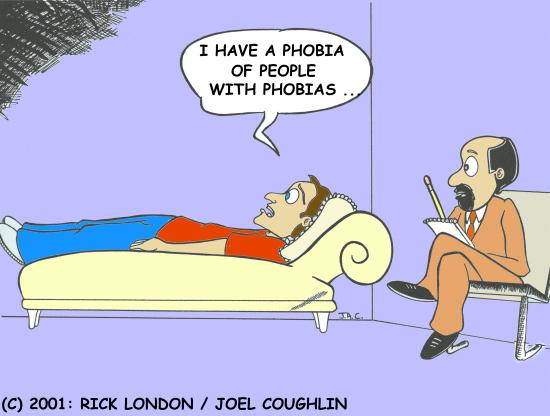
What about giving your character a fear? Fears are often debilitating and defining. I found a great website that lists fears, probably all the ones known to mankind.


For instance, if you have a character with ablutophobia, the fear of washing or bathing, it will really define them. First of all, they'll stink like hell. They don't buy soap. They don't have many friends, although flies love them, and they probably rarely leave their house.


If your character has botanophobia, the fear of plants, they probably live in the city, in a highrise and all their friends know, when they're shot, not to bring them flowers in the hospital. Although, they may not mind flowers on the coffin. I wonder, would they even want to be buried? It's kinda plant-like...


Here are a few of my other favorites:

   So, don't dismay. There are a lot of interesting people out there from which to base your characters on.

Tuesday, 29 December 2009

Plot: When in doubt, act it out!


After I finish the first draft, I always take and print out my pages. I like the look of 400 pages -- what an accomplishment! I put my manuscript away for a few weeks before starting my first edit. I have the desire to start immediately but quash it. I occupy my time dreaming up my next plot or work on my blog.

When I start to edit, I have a process. One thing I like to do is take each scene, or for some of you, each chapter, and act out the characters in turn.

1) I highlight each character's actions and their lines in a different color
2) I visualize the scene in my head (what the room or area looks like)
3) I visualize what my character is wearing and holding or doing
4) Then, I direct myself as each character-- moving around and saying each line.

Why? Why is this sometimes a good idea?

When reading through your work, sometimes it's easy to miss errors. Perhaps a minor character was standing in a doorway and  then he's in the attic. Perhaps he's wearing a red jumper and then he pulls a mobile from his jacket pocket. Was he wearing a jacket?

I'm not saying this works every time but you can catch many inconsistencies. When in doubt, act it out!

Saturday, 17 October 2009

Characters that we love...

I'm in the middle of editing my second book. A book I think is absolutely fabulous -- I think it's wrong to love your own writing this much -- and I'm afraid that eventually, I will be brought back down to earth. Ah, well, I write because I have to. If I didn't, I would go crazy. My characters want me to tell their story. So what option do I have.

Now, about characters...what can I say about characters? I think this: You know your characters are real and you know them well if they manage to surprise you every once in awhile. I love writing a chapter, and in my mind I know exactly where it's going, and then bam! my character pulls a stunt. Although I'm the writer and I could just push the delete button on their actions, I know I can't. Because I know that's exactly what they would do in that situation.

I just have to change the plot to match the characters.

That, in my opinion, is how I know I know my characters really well.