Showing posts with label Shakespeare's Sonnet Sunday. Show all posts

Sunday, 11 April 2010

Shakespeare's Sonnet Sunday - Sonnet 14

Not from the stars do I my judgement pluck;
And yet methinks I have Astronomy,
But not to tell of good or evil luck,
Of plagues, of dearths, or seasons' quality;
Nor can I fortune to brief minutes tell,
Pointing to each his thunder, rain and wind,
Or say with princes if it shall go well
By oft predict that I in heaven find:
But from thine eyes my knowledge I derive,
And, constant stars, in them I read such art
As truth and beauty shall together thrive,
If from thyself, to store thou wouldst convert;
Or else of thee this I prognosticate:
Thy end is truth's and beauty's doom and date.

1. I don't get my knowledge of the future (discernment) from the stars
2. And yet I think I have Astronomy (a way to see into the future),
3. But not to tell of good or evil luck,
4. Of plagues, of food shortages, or how well the crops will do.
5. Nor can I be accurate as to what your fortune will be,
6. Whether you will be hit by bad fortune (rain, wind, thunder),
7. Nor say if princes will have a good life
8. by often predicting the stars.
9. But from your eyes I find my knowledge,
10. And, in your bright shining eyes (constant stars) I can predict
11. that inner truth and outer beauty continue to conquer,
12. if you will turn your mind to (convert) keeping this truth and beauty (through children)
13. Or else I can predict (prognosticate) this:
14. The date of truth and beauty death (doom).

Sunday, 4 April 2010

Shakespeare's Sonnet Sunday - Sonnet 13

O! that you were your self; but, love, you are
No longer yours, than you your self here live:
Against this coming end you should prepare,
And your sweet semblance to some other give:
So should that beauty which you hold in lease
Find no determination; then you were
Yourself again, after yourself's decease,
When your sweet issue your sweet form should bear.
Who lets so fair a house fall to decay,
Which husbandry in honour might uphold,
Against the stormy gusts of winter's day
And barren rage of death's eternal cold?
O! none but unthrifts. Dear my love, you know,
You had a father: let your son say so.

1. O! I wish you could stay as you are; but, love, you are
2. only going to be here for as long as your life.
3. You should prepare yourself for death,
4. Give your beauty to your children:
5. So that your beauty which you only have for a few years
6. will not end; but there will be a copy
7. of yourself, after your dead,
8. When your child, who likes like you, is born.
9. Who lets a beautiful house (lineage or family) fall to pieces,
10. when you could, as an honorable husband, prevent,
11. old age
12. and death stopping the family line?
13. Only the irresponsible husbands, that's who. Dear my love, you know,
14. You had a father: let your son say he's had one too. Have children already.

Sunday, 28 March 2010

Shakespeare's Sonnet Sunday - Sonnet 12

When I do count the clock that tells the time,
And see the brave day sunk in hideous night;
When I behold the violet past prime,
And sable curls, all silvered o'er with white;
When lofty trees I see barren of leaves,
Which erst from heat did canopy the herd,
And summer's green all girded up in sheaves,
Borne on the bier with white and bristly beard,
Then of thy beauty do I question make,
That thou among the wastes of time must go,
Since sweets and beauties do themselves forsake
And die as fast as they see others grow;
And nothing 'gainst Time's scythe can make defence
Save breed, to brave him when he takes thee hence.


I have been doing a sonnet a week for twelve weeks. When I started, I knew nothing of Shakespeare. When it came to Shakespeare, I considered it beyond my comprehension. Throughout high school , when my teachers would say to me, this is how this line is to be understood, I thought they were ridiculous to assume to know the poetry. How wrong I was. After about ten weeks of trying to decipher the sonnets, I can truly say, I'm beginning to understand the writer.  


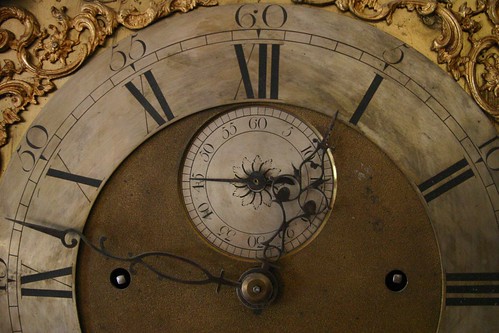
Here's the twelfth sonnet and from what I understand, Shakespeare talks about time and clocks. Fitting then it should be the 12th sonnet(12 hours on a clock), don't you think?

1. When I add up the years that have gone by (count the chimes a clock makes - more chimes the bells make as time passes)
2. And see youth turn old;
3. When I behold the violet(spring) past prime(turn old and die),
4. And the dark hair of youth, turned white with age;
5. When lofty trees I see barren of leaves (fall and winter...time again past),
6. A tree that used to cover the herd in shade,
7. And summer's green (wheat or barley in the summer) all tied up in bails(harvest - which happens in the fall),
8. Put on the bier (cart drawn by a horse) with white and bristly beard (see picture - wheat has a beard called an awn when ready for harvesting) Note: The horse and cart also used to carry coffins.
9. Then I think about what will happen to your beauty,
10. Eventually time, will make your beauty fade and die,
11. Just like all things sweet and beautiful
12. that die and become replaced by other things sweet and beautiful;
13. There is nothing that can fight against time's weapon
14. Except for children to continue to fight against time when you die.

Sunday, 21 March 2010

Shakespeare's Sonnet Sunday - Sonnet 11

As fast as thou shalt wane, so fast thou grow'st
In one of thine, from that which thou departest;
And that fresh blood which youngly thou bestow'st,
Thou mayst call thine when thou from youth convertest.
Herein lives wisdom, beauty, and increase;
Without this folly, age, and cold decay:
If all were minded so, the times should cease
And threescore year would make the world away.
Let those whom nature hath not made for store,
Harsh, featureless, and rude, barrenly perish:
Look whom she best endow'd, she gave the more;
Which bounteous gift thou shouldst in bounty cherish:
She carv'd thee for her seal, and meant thereby,
Thou shouldst print more, not let that copy die.

1. As fast as you age is how fast
2. your children that come after you shall age;
3. And the children that you bring to this world,
4. You may call your when your youthfulness is gone.
5. In your children, wisdom, beauty, and increase to your family will continue;
6. But, without producing children, you are only left with folly, age, and then death.
7. If everyone thought this way, life on earth would cease
8. in thirty years as the last person died.
9. Let those who do not have fine qualities,
10. those who are harsh, ugly, and rude die without adding to the world.
11. But those who have a lot to give, those with many fine qualities,
12. qualities that you should value.
13. Nature gave you these qualities so that
14. you should make more copies of you in the form of children.

Pic source: http://www.wolverhamptonhistory.org.uk/people/victorian_childhood/playtime/painting

Sunday, 14 March 2010

Shakespeare's Sonnet Sunday: Sonnet 10

For shame deny that thou bear'st love to any,
Who for thy self art so unprovident.
Grant, if thou wilt, thou art beloved of many,
But that thou none lov'st is most evident:
For thou art so possessed with murderous hate,
That 'gainst thy self thou stick'st not to conspire,
Seeking that beauteous roof to ruinate
Which to repair should be thy chief desire.
O! change thy thought, that I may change my mind:
Shall hate be fairer lodged than gentle love?
Be, as thy presence is, gracious and kind,
Or to thyself at least kind-hearted prove:
Make thee another self for love of me,
That beauty still may live in thine or thee.

This is a continuation of Sonnet 9 in a sense...
1) Shame on you that you don't love any
2) Because really you are not looking towards your own future.
3) Though you are loved by many,
4) It is clear that you don't love any.
5) You have such a desire not to have children
6) It is only against yourself that you are ruining
7) You will ruin that family line
8) But it should be most important to keep it going.
9) Change your attitude so that I will change my view of you.
10) Will hate win out rather than love?
11) Be as you profess to be: gracious and kind.
12) Or at least be kind to yourself.
13) Make offspring, if not for yourself, do it for me.
14) That beauty (both in attitude and in offspring) may continue in you.

Sunday, 7 March 2010

Shakespeare's Sonnet Sunday: Sonnet 9

Is it for fear to wet a widow's eye,
That thou consum'st thy self in single life?
Ah! if thou issueless shalt hap to die,
The world will wail thee like a makeless wife;
The world will be thy widow and still weep
That thou no form of thee hast left behind,
When every private widow well may keep
By children's eyes, her husband's shape in mind:
Look what an unthrift in the world doth spend
Shifts but his place, for still the world enjoys it;
But beauty's waste hath in the world an end,
And kept unused the user so destroys it.
No love toward others in that bosom sits
That on himself such murd'rous shame commits.

If one reads through this poem, by now, you should recognize that it's also about procreating.

1) Are you afraid to make a widow cry?
2) That you waste away in singleness?
3) Ah! If you happen to die without children,
4) The world will mourn as if it were your wife;
5) It will be your widow and weep.
6) Because you left no children behind,
7) Rather than leave your widow
8) a child that she could keep her husband's form and image in mind.
9) Whatever you spend in the world, money and things,
10) Will just circulate and the world can enjoy it for many years...
11) But beauty will come to an end
12) And if you don't create more beautiful creatures, eventually it will be gone forever.
13) You have no love towards others
14) If you keep all chances of producing an heir to yourself.

Sunday, 28 February 2010

Shakespeare's Sonnet Sunday: Sonnet 8

Music to hear, why hear'st thou music sadly?
Sweets with sweets war not, joy delights in joy:
Why lov'st thou that which thou receiv'st not gladly,
Or else receiv'st with pleasure thine annoy?
If the true concord of well-tuned sounds,
By unions married, do offend thine ear,
They do but sweetly chide thee, who confounds
In singleness the parts that thou shouldst bear.
Mark how one string, sweet husband to another,
Strikes each in each by mutual ordering;
Resembling sire and child and happy mother,
Who, all in one, one pleasing note do sing:
Whose speechless song being many, seeming one,
Sings this to thee: 'Thou single wilt prove none.'


1. Why is it that, when there is music to listen to, you are saddened by it?
2. Happy music should result in happiness.
3. Why do you pretend to love what you don't really want?
4. And receive with pleasure what clearly annoys you?
5. If the uniting sounds
6. Played together in harmony offend you,
7. If they bother you when together
8. But played alone you can bear it
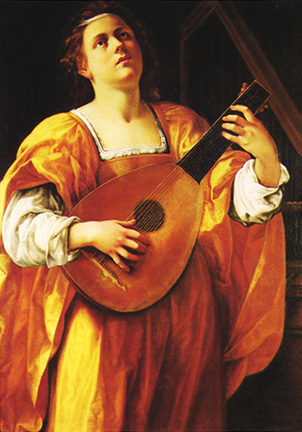
9. Look at how the strings, played together on the Lute (popular in Shakespeare's day)
10. The strings reverberate against each other in appropriate order.
11. Like a happy family with husband, child and mother
12. Who together make a happy sound.
13. Though made up of many components are actually one.
14. And one string played alone will actually be nothing.

This sonnet can have two meanings...

1) The one above or...

2) The idea of marriage with it's responsibilities to wife and bearing children may seem tiresome. Being single is like playing only one string of an instrument or one instrument of an orchestra... it's really nothing.


Sidenote: Going to the USA/Mexico border today... if you don't hear from me in a few days... well. Not to worry you, I'll probably be fine. It's an adventure... right?


Sunday, 21 February 2010

Shakespeare's Sonnet Sunday: Sonnet 7

Phoebus in Greek mythology
Lo! in the orient when the gracious light
Lifts up his burning head, each under eye
Doth homage to his new-appearing sight,
Serving with looks his sacred majesty;
And having climbed the steep-up heavenly hill,
Resembling strong youth in his middle age,
Yet mortal looks adore his beauty still,
Attending on his golden pilgrimage:
But when from highmost pitch, with weary car,
Like feeble age, he reeleth from the day,
The eyes, 'fore duteous, now converted are
From his low tract, and look another way:
So thou, thyself outgoing in thy noon
Unlooked on diest unless thou get a son.

There is a great deal of meaning in this poem. It could compare the sun, which men look upon with wonder as it rises in the east (sunrise) and watch it work it way over the earth. However, as it approaches noon, and the sun beats down heavily upon the earth's occupants, we are forced to look away because of its brightness and from it's zenith or high-point it's only downhill from there, the daylight will soon be gone. Like a human approaching middle age if he doesn't have a child before the end of his prime, people will only look down on him as he approaches death.

1. Look! in the morning when the sun (because, as we know, the sun rises in the East)
2. Rises over every human
3. We pay respects to his appearing in the day
4. By gazing upon it.

5. And by rising into the sky...or advancing in time (the chariot of the sun, driven by Phoebus in Greek mythology, climbs up the steep slope of the sky.)
6. It still remains beautiful even to middle age (midday)
7. We still look upon its beauty
8. As the sun makes his way across the sky.
9. But when it reaches the highest point in the sky (midlife) having used up its useful energy.
10. Like old age, it starts its descent.
11. Our eyes, before in awe, are changed
12. From his lowest point and soon we forget the sun
13. So youth, you will soon pass your prime
14. And die unnoticed unless you have a son.

Sunday, 14 February 2010

Shakespeare's Sonnet Sunday: Sonnet 6

Then let not winter's ragged hand deface,
In thee thy summer, ere thou be distilled:
Make sweet some vial; treasure thou some place
With beauty's treasure ere it be self-killed.
That use is not forbidden usury,
Which happies those that pay the willing loan;
That's for thy self to breed another thee,
Or ten times happier, be it ten for one;
Ten times thy self were happier than thou art,
If ten of thine ten times refigured thee:
Then what could death do if thou shouldst depart,
Leaving thee living in posterity?
Be not self-willed, for thou art much too fair
To be death's conquest and make worms thine heir.

1. Don't let old age's wrinkles ( raggedly) disfigure you
2. While you're still young, before you have children (distillation is made of your essence)
3. Have children and make some woman's womb happy with your seed (treasure)
4. Have children before you no longer can.
(Back then, the man's seed was considered to be the essential substance for the generation of new life. Women's function in the reproductive process was not understood. The woman was thought to be no more than the vehicle for carrying the man's progeny.)
5.Using your seed for gain is not forbidden
(use in the technical sense of usufruct,interest, making money by lending it out. Usury was considered sinful, but a ten percent return on money was legally permitted. The usurers performed the function of modern day banks) 6. Especially because it makes those happy who gain from it with children.
7. Because you only gain if you make another of you
8. Or ten times happier, if you have ten children instead of one.
9. Having ten children would make you ten times happier than if you only had one child, or certainly happier than you are in your present childless situation.
10. Ten children will keep ten fresh images of you around and more if they have grandchildren.
11.Then, if you die, death hasn't won
12. Because you will still live through your children. 13. Do not be stubborn, for you are too good for that.
(There is a sexual innuendo derived from will. Hence ' do not devote yourself to self-pleasure'.)
14. You do not want death to win and leave only worms to benefit from you (breeding from your corpse). (Also apparently there is a legal meaning of conquest: - property acquired by means other than inheritance (usually by force of arms).)


Source: Shakespeare's Sonnets

Sunday, 7 February 2010

Shakespeare's Sonnet Sunday: Sonnet 5

Those hours, that with gentle work did frame
The lovely gaze where every eye doth dwell,
Will play the tyrants to the very same
And that unfair which fairly doth excel;
For never-resting time leads summer on
To hideous winter, and confounds him there;
Sap checked with frost, and lusty leaves quite gone,
Beauty o'er-snowed and bareness every where:
Then were not summer's distillation left,
A liquid prisoner pent in walls of glass,
Beauty's effect with beauty were bereft,
Nor it, nor no remembrance what it was:
But flowers distill'd, though they with winter meet,
Leese but their show; their substance still lives sweet.
 This poem takes you through season ie. the years of your life...
1) The (hours) time that nature (gentle work) spent on you making (frame) you what you are - beautiful
2) The face (gaze - your face has eyes to gaze) or beauty that everyone sees
3) Well, those hours or time will be cruel (a tyrant) to that same beauty.
4) And make ugly (unfair) the beauty(fairly) that you have
5) Time will bring upon summer (time, another season, more years)
6) Til finally you reach the end (winter - last season) where it will destroy (confounds).
7) Young beauty (sap-spring) now old (frost -winter) well past prime (autumn leaves)
8) Beauty is gone and barren.
9-10) If you can't hold on to beauty like the fragrant flowers perfumed in a glass vial*
11) Then beauty will be lost (bereft)
12) The beauty and its remembrance of it would be lost.
13) But if you could capture it (flowers distilled), even if winter came,
14) The flowers (outward beauty) would be gone but the sweet smell (internal essence/being) will remain.


*This refers to the distillation of perfume from fragrant flowers, such as roses. Rosewater was much in demand for sweetmeats, confections and kissing-comfits. The distillate would be kept in a glass vessel, a vial.

Source: http://www.shakespeares-sonnets.com
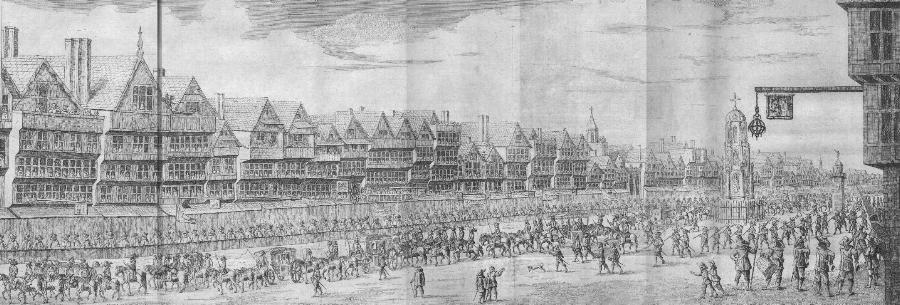
PIC Source: Description des Royaumes D'Angleterre et D'Ecosse. Composé par Estienne Perlin.Par. 1558. Histoire de LEntree de La Reine Mere dans La Grande Bretagne.Par. 1639.
Re-printed by W.BOWYER and J.NICHOLS:For T. PAYNE and W. BROWN.LONDONM DCC LXXV(1775)
PIC Source: http://www.bottlebooks.com

Sunday, 31 January 2010

Shakespeare's Sonnet Sunday: Sonnet 4

1) Unthrifty loveliness, why dost thou spend
Upon thy self thy beauty's legacy?
3) Nature's bequest gives nothing, but doth lend,
And being frank she lends to those are free:
5) Then, beauteous niggard, why dost thou abuse
The bounteous largess given thee to give?
7) Profitless usurer, why dost thou use
So great a sum of sums, yet canst not live?
9) For having traffic with thy self alone,
Thou of thy self thy sweet self dost deceive:
11)Then how when nature calls thee to be gone,
What acceptable audit canst thou leave?
13) Thy unused beauty must be tombed with thee,
Which, used, lives th' executor to be.


Line one and two:  You wasteful person that spends his wealth or time on yourself rather than on your children. 
Line three: The qualities given you are not yours, you need to repay.
Line four: Nature gives generously to those who are open-hearted, free spirited.
Line five: You beautiful bastard, why are you so wasteful.
Line six: The qualities given you.
Line seven and eight:  You unsuccessful silly-man, why do you use so much now and not be able to carry one in the future.
Line nine and ten: Spending on yourself alone, you rob both your offspring and deceive yourself.
Line eleven and twelve: When you die, what acceptable legacy will you be leaving behind?
Line thirteen: Your beauty will die with you because you never procreated.
Line fourteen: But if you pass on your beauty, it will live in the future as your children.

Amongst these legal and financial metaphors, there is possibly another, slyer, system of imagery. Since the poem’s subject is the beloved refusal to bring his undoubted sexual attractions into the service of reproduction, the contrast between “use” and “abuse” is open to another, cruder, interpretation. Certainly the cluster of terms like “spend/ Upon thyself”, “traffic with thyself” and “abuse” could be read as innuendo of a specifically sexual nature.

Picture: Who they suspect the first four sonnets are about - Henry Wriothesley, 3rd Earl of Southampton

Read more at Suite101: Shakespeare's Sonnet No.4

Sunday, 24 January 2010

Shakespeare's Sonnet Sunday: Sonnet 3


Look in thy glass and tell the face thou viewest
Now is the time that face should form another;
Whose fresh repair if now thou not renewest,
Thou dost beguile the world, unbless some mother.
For where is she so fair whose unear'd womb
Disdains the tillage of thy husbandry?
Or who is he so fond will be the tomb
Of his self-love, to stop posterity?
Thou art thy mother's glass and she in thee
Calls back the lovely April of her prime;
So thou through windows of thine age shalt see,
Despite of wrinkles this thy golden time.
But if thou live, remember'd not to be,
Die single and thine image dies with thee.


What do I get from this sonnet? Its a continuation of Sonnet1 and 2.

  1.  Look in the mirror, whose face do you see?
  2.  You should make offspring that look like you.
  3.  If you don't work at making yourself look beautiful,
  4.  You cheat the world and some mother that could give birth.
  5.  Where is this woman that won't have sex with you,
  6.  who hates the thought of being a wife?
  7.  Who is foolish to love death
  8.  or his selfishness to forget carrying on his lineage?
  9.  You look just like your mother...
  10.  when she was young.
  11.  You can see now with your eyes,
  12.  what she was like back then even though she has wrinkles - a beauty.
  13.  But if you live, determined not to be remembered,
  14. then you will die childless, and your beauty will die with you. 
Maybe not a literal translation. All I can say about it is: Good grief, man, have a child already, how hard can it be?

Shakespeare, William. Sonnet 3. Ed. Amanda Mabillard. Shakespeare Online. 20 Aug. 2000. (date when you accessed the information) < http://www.shakespeare-online.com/sonnets/3detail.html >.

Sunday, 17 January 2010

Shakespeare's Sonnet Sunday: Sonnet 2


When forty winters shall besiege thy brow,
And dig deep trenches in thy beauty's field,
Thy youth's proud livery so gazed on now,
Will be a totter'd weed of small worth held:
Then being asked, where all thy beauty lies,
Where all the treasure of thy lusty days;
To say, within thine own deep sunken eyes,
Were an all-eating shame, and thriftless praise.
How much more praise deserv'd thy beauty's use,
If thou couldst answer 'This fair child of mine
Shall sum my count, and make my old excuse,'
Proving his beauty by succession thine!
This were to be new made when thou art old,
And see thy blood warm when thou feel'st it cold.


What does the poem mean? Interestingly, it took until I read sonnet two to discover the poem rhymed. Why, oh why, am I discussing poetry, a subject I know so little about? I guess it's to get better at it.

The second sonnet is a continuation of the first, Shakespeare is talking a man that seems more interested in his looks than procreating. (I think something's wrong with him personally.) I read somewhere that the poet used his sonnets to make a point with his friends.

For example, this poem is meant for a specific man. Much debate has surrounded the true identity of Shakespeare young man, but many believe he was the Earl of Southampton(picture right), the poet's close friend and patron.

In my opinion, I don't see how he's good-looking at all but I guess the man thought he was 'all-that'. The Earl of Southampton did eventually pass on his good looks to his children and married... and caused a stir... and ended up in prison, but perhaps it was Shakespeare that gave him the push in that direction.

Sunday, 10 January 2010

Shakespeare's Sonnet Sunday: Sonnet 1


From fairest creatures we desire increase,
That thereby beauty's rose might never die,

But as the riper should by time decease,

His tender heir might bear his memory:

But thou contracted to thine own bright eyes,

Feed'st thy light's flame with self-substantial fuel,
Making a famine where abundance lies,
Thy self thy foe, to thy sweet self too cruel:
Thou that art now the world's fresh ornament,
And only herald to the gaudy spring,
Within thine own bud buriest thy content,
And, tender churl, mak'st waste in niggarding:
Pity the world, or else this glutton be,
To eat the world's due, by the grave and thee.


Now the modern version:

We want beautiful people to have children.
So that, in good time, all Brits will have good teeth.
And when the old die...
The good looking, with good teeth, will still be around for us who have gone through corrective dental surgery.
But you, you like what you see in the mirror.
And feel content to just stand there and not procreate. (What's the matter with you!?)
Oh, listen to the women weeping!
The ugly will rise and take over the earth!(And all our movies will be Avatars)
Because you, you vain man, though you are the newest sweeeet thing,
And can lift us from downcast spirits,
You keep your beauty to yourself.
What a bloody waste! (Niggarding means stingy, in case you felt offended.)
Take pity on us uglies or continue to be a selfish glutton,
Give us our beautiful children or take your beauty to the grave.


To sum up: If your good-looking, have lots of babies.

What was the bard thinking when he wrote this?
'And I must say, I am one fine looking chap. Now, why does not my wife want to make lots of babies with me?'

When did he write this?
Pretty early in the day, I'd imagine. Here's the scene:
'Bill, it's early, I'm sleeping. Stop it, don't touch me there. Look, this is off limits until you make us some bloody money, now shoo, I'm sleeping.' (Liberties taken.)

Source: Analysis of Shakespeare